

With a justifiably strongreputation in the mid-capacity sports segment, the Ninja 650 delivers Kawasakiriding excitement with its strong low-mid range-focused 649cc ParallelTwin engine mated to a lightweight and compact chassis. For 2027, the new Ninja650 further enhances riding fun thanks to updated front-end components plusother refinements to sharpen its sporty handling character and strengthen itsNinja appeal.
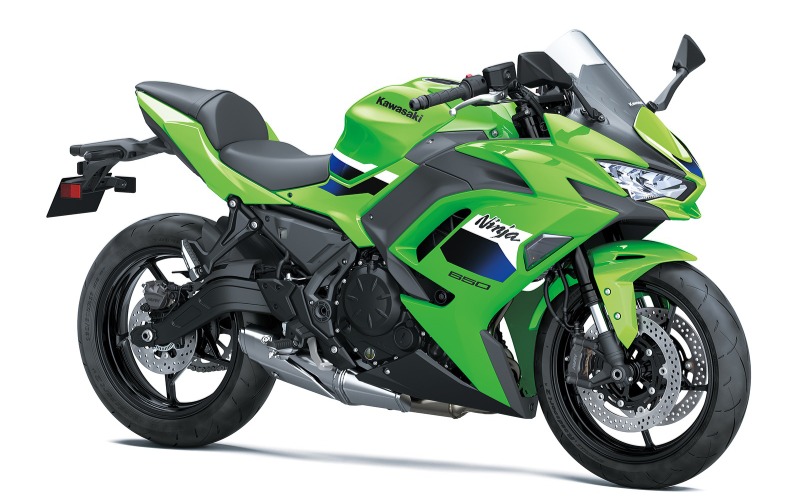
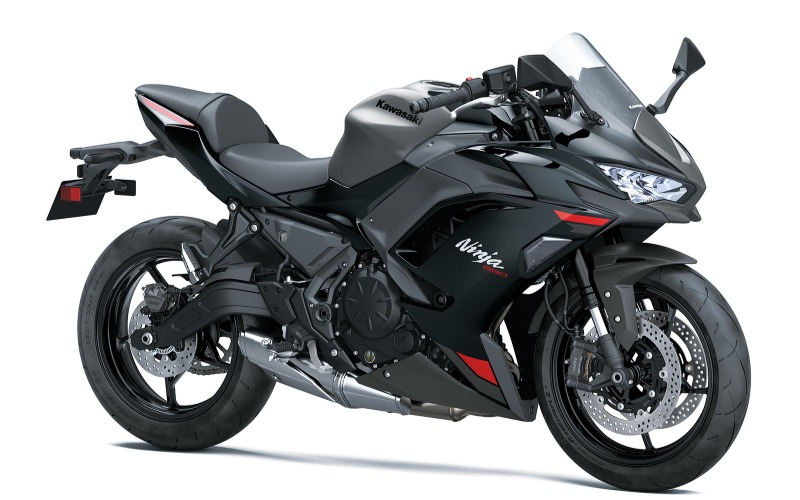
Replacing the telescopic front fork of the previous model, a Showa ø37 mm SFF-BP inverted front fork is now fitted. Reducing the damping pressure via the adoption of a larger piston than previous iterations creates greater control and calm attitude changes while also offering greater chassis stability on corner entry plus a planted braking feel. The updated rear suspension setting – via an uprated spring rate – pairs well with the new inverted front fork, maintaining the Ninja 650’s rider-friendly character and natural handling feel.
In terms of braking, the previous axial-mount front brake calipers have been replaced with radial-mount items. Additionally changing from 2-piston to 4-piston calipers improves response to lever input, contributing to linear, controllable braking performance. Also, a newly designed front fender features a wider lateral design with a shape more fully covering the fork outer tubes.
The combination of these suspension and braking updates contributes to improved road-holding performance and greater control, supporting more spirited sport riding while maintaining the previous model’s light, natural handling character. The result is a 2027 package that allows a wide range of riders to enjoy the fun of controlling this popular machine with confidence.
Other key features include a new 4.3 inch TFT colour instrument display which offers highly visible information at a glance, contributing to an even more high-tech cockpit appearance. Smartphone connectivity via the Kawasaki Rideology App now supports navigation and voice command functions, further increasing convenience and riding enjoyment.
Equipped with a lightweight trellis chassis and a commendably low seat height of 785mm, rider convenience is enhanced by additional features such as KTRC Traction Control – with two rider-selectable modes – and an accessory option of a quick shifter for seamless upshifts.
The end result? A sharper Ninja 650 for 2027 with increased sport riding potential combining its already established sleek Ninja styling and approachable character to deliver an updated Fun-Style-Easy concept.
The Ninja 650 will be available from December, priced at £7,499.
2027 Colours:
- Lime Green
- Metallic Flat Spark Black / Metallic Carbon Gray
The road going Ninja H2 and track-only Ninja H2R became instant icons at their launch a decade or so ago illustrating the corporate strength of the Kawasaki group. Not just motorcycling engineers but aerospace and gas turbine division specialists were involved in the creation of these groundbreaking forced induction machines that feature the elusive “River Mark” reserved exclusively for selected models of historic significance and exceptional engineering.
Now, reintroduced for the 2027 model year, the latest iteration of the famous Ninja H2 proudly takes its place as an evolution of Kawasaki’s supercharged flagship refined for today’s riding environment. Updated in many key areas, the unique Ninja H2 now delivers even greater mid-range torque plus a distinctive high-rpm acceleration sensation all combining to create an exotic formula.
At the heart of these impossible-to-ignore machines is the engine and – although outwardly similar to the previous model – there are myriad changes. As example, the impeller and intake system represent a complete redesign; the pistons, cylinder head, cylinder, crankshaft and camshafts are new; throttle bodies are new; exhaust system is new and gear ratios revised. With maximum torque delivered at 8500rpm and a peak power (with Ram Air) of 209PS, the Ninja H2 is truly a distinctive rider focused performance machine.
As with the previous model, a trellis frame offers a balance of stiffness and flexibility enabling a very high level of stability plus the Ninja H2 becomes the first Kawasaki model to adopt Brembo Hypure front brake calipers. These offer a lightweight design while providing high rigidity and linear response. The new exhaust system features optimised pipe diameters and a redesigned pre-chamber layout and compact silencer, resulting in a lighter system that contributes to increased low to mid-range torque.
For the rider environment, things also change in terms of the meter panel and elements of functionality. The updated instrumentation offers two selectable display types. Type 1 features a layout inspired by the silhouette of the air ducts, while Type 2 features enhanced boost and aviation-inspired lean/attitude displays. Naturally there are a suite of rider aids including revised KTRC traction control and KLCM launch control plus many others as well as Smartphone connection via Kawasaki’s Rideology App.
Naturally, suspension is the highest quality with KYB AOS-II at the front while, at the rear, an Öhlins TTX36 shock contributes to stability. Additionally, alongside the standard machine, the limited-edition Ninja H2 CARBON is once more available featuring a carbon-fibre upper cowl made from high-rigidity, lightweight CFRP (Carbon-Fibre Reinforced Plastic).
And as if that were not enough, the 300+ horsepower track-only Ninja H2R is still available on an order only basis for those that seek the best of the best. 2027 certainly seems to be shaping up to be not just a super but a truly supercharged year for Kawasaki.
These machines will be arriving in the UK in VERY limited numbers at the end of the year, therefore we suggest speaking to your local Kawasaki dealer as soon as possible to find out more about securing your purchase. The Ninja H2 is priced at £28,600, the Ninja H2 Carbon will cost £31,350, and the H2R £52,000.
2027 Colour for both Ninja H2 and H2 Carbon:
Mirror Coated Spark Black
The Ninja H2 and H2 Carbon feature the following electronic rider aids:
- KCMF (Kawasaki Cornering Management Function)
- KTRC (Kawasaki TRaction Control)
- KLCM (Kawasaki Launch Control Mode)
- KIBS (Kawasaki Intelligent anti-lock Brake System)
- KQS (Kawasaki Quick Shifter)
- Kawasaki Engine Brake Control
- Öhlins Electronic Steering Damper
- Electronic Cruise Control